Showing posts with label England. Show all posts

HOW DICKENS HELPED SAVE CHRISTMAS

"I will honour Christmas in my heart, and try to keep it all the year." -Ebenezer Scrooge
Illustration by Lisbeth Zwerger, source

Following intense scrutiny by Oliver Cromwell and his largely Puritan Parliament, Christmas celebrations in Great Britain were in decline. At the same time, the Industrial Revolution allowed British workers little time for the holy days. 

But Christmas celebrations began to make a comeback in the mid 1800's, in great part due to Queen Victoria, Prince Albert, and... Charles Dickens! 

Happy Birthday to A Christmas Carol, published 169 years ago today, on December 19, 1843! I love this beautiful edition, illustrated by Lisbeth Zwerger.

According to Laura Grande, who writes in History Magazine: Christmas still was not observed by the majority of the population, as workhouses and mill owners refused to recognize it as a holiday, forcing their employees to work their usual shifts, which often ran longer than 10 hours a day. With the majority of England at work, it’s no small wonder that Christmas still went largely unrecognized.

Dickens began writing "A Christmas Carol" in October of 1843 and the novella was completed within six weeks.

By Christmas Eve, all 6,000 copies had sold out and it continued to sell out with each new edition well into the following year.


The observance of Christmas had experienced a mid-Victorian revival, with a heavy emphasis on family-oriented festivities. 


Dickens was hailed as a hero and he did public readings of "A Christmas Carol" every holiday season from 1853-70. In total, Dickens had read his book aloud to massive crowds 127 times.
{source: Laura Grande, from December 2010/January 2011 issue of History Magazine. I found the article in its entirety, here.}

Another nice edition of Dicken's A Christmas Carol is this one, illustrated by P.J. Lynch.  You can see many of his illustrations for the book here, on his website.

Read more about the life of Charles Dickens, HERE, in my past post commemorating his 200th Birthday this year.

From Page to Stage: WAR HORSE

I just finished reading Michael Morpurgo's incredibly poignant book, War Horse (1982).  A short novel written for children (ages 10 and up), it's packed with power and emotion.  The story is told from the point of view of the horse, "Joey": which I think is brilliant, given the tough subject matter for children.

Through the eyes and ears of Joey we get to know the story's characters and eventually see the devastation and havoc wrecked on the British and German armies and their horses - who served as mounts and beasts of burden to the officers and soldiers of both sides - during WWI.  Sadly, most of the horses were killed just as tragically as their human masters.

I have not been lucky enough to see the stage production of War Horse (adapted by Nick Stafford in 2007), but my husband and I rented the recent Stephen Spielberg film (December 2011).  I found myself wishing I didn't have to watch the graphic brutality of war that had been mostly left to my imagination in the book.

Scene from the movie

The stage production stars life-size puppets as the horses - created by Handspring Puppet Company of South Africa. This Tony Award-winning production is the reason for the previously unheralded book's present popularity and recent film adaptation.

Scene from the play

In my opinion, the story translated better to the stage than screen, maybe because of the difference in the way we focus on the horses as puppets in the play: they are magnificient and heroic in a magical way. Also, with minimal scenery and props, the audience is still expected to use their imaginations for much of the action.

In both the film and play versions of War Horse, the story was re-written from the first person point of view to the third person, resulting in the audience experiencing the horse Joey as a character, rather than the narrator. The role of Joey as the heart of the story seems to have been better preserved in the stage play then in the film.

Granted, I'm making this assessment and comparison of the film to what I've only seen of the stage production online, but you can judge for yourself the impact this play performed live would have on family audiences...
Martha Teichner talks to the team behind "War Horse," from CBSNewsOnline: 

Some background about the writing of the novel...
From the Imperial War Museum, Mr. Morpurgo learned that between one million and two million British horses had been sent to the front lines in the first World War, and that only 65,000 or so had come back. He resolved to write about them but struggled to find the right voice.

Then one evening he was at the farm he and his wife run in Devon, where poor children come to work with animals. (There are now three in Britain, and one in Vermont.) He was passing through the stable yard when he saw one of the children, a troubled boy who had a bad stutter and had not uttered a word in school in two years, standing head to head with a horse.

“He started talking,” Mr. Morpurgo recalled. “And he was talking to the horse, and his voice was flowing. It was simply unlocked. And as I listened to this his boy telling the horse everything he’d done on the farm that day, I suddenly had the idea that of course the horse didn’t understand every word, but that she knew it was important for her to stand there and be there for this child.” That became Joey’s role in “War Horse” — observer and witness as much as protagonist.
Source:  NYTimes article: "Undaunted Author of War Horse Reflects on "Unlikely Hit"

For Further Behind-the-Scenes Reading about the play, you might like this:
NYTimes Q&A Interview with the Puppeteers of War Horse


SENTIMENTAL JOURNEY II: NAVIGATING THE LOSS OF OUR GOOD NATURED DADDY BEAR

C.S. Lewis wrote: "grief is like a long valley, a winding valley where any bend may reveal a totally new landscape."

On the road near Ashburton, Dartmoor in Devon, England, 1982.
After my dad's sudden passing away from cancer on July 1st, our family slowly began to find our way through the winding valley of grief together.

We took the bends in the road one at a time. This new landscape of separation, dotted with familiar objects that would bring a flood of happy memories along with pangs of loneliness, often felt disorienting:  seeing photos everywhere of Dad vibrant and alive; his handwritten "to do" list on his desk; his customary place next to my mom now empty on the bench where they sat together on the back deck; and his glasses that he'd worn so recently, lying still and unused on the bedside table.

As my siblings left one by one after the funeral, I stayed with my mom, and brother Fr. Peter Jon and his family, in Indiana for several weeks. We began to allow ourselves to accept this new reality of daily life void of Dad's physical presence, while appreciating the new relationship and eternal presence our family was building with him spiritually.

Separately, though together, Mom and I endured many moments that could have been numbingly empty; but thankfully we experienced the mutual comfort that comes from the tender and honest companionship of another who has been left behind, as well as the blessed grace that is God's gift.

One afternoon, in search of something to read, I pulled out a vaguely familiar volume, bookended with others between a couple of heavy gilded lions on a table that I'd walked past several times a day. The spine bore the title, The Good Natured Bear.

I opened the cover to experience a little jolt of recognition, accompanied by the (lately) ever present feeling of bright sadness, as I read my own handwriting:

To my sweet Daddy Bear -- a present from our Ashburton bookstore.  
Love, Wendy Bear. Christmas '82 

My mom took this photo of me in Dartmoor,
while we were on a family trip to England
when I was 18 years old.
Tears began to flow as I recalled the day I had bought the book.  It was while we were on a family vacation in England during the summer of 1982.  For part of our visit, we stayed in a 17th Century house in the quaint town of Ashburton, which is located on the southern slopes of Dartmoor in the South Devon countryside.

This day, it was raining.  Ever the romantic, Dad, after making us kids some popcorn, had invited Mom to go walking and exploring in the rain. They left, turning down the narrow alleyway which led out to the shops, and around a corner, where they stumbled upon a cozy used bookshop.  They quickly came back and got us kids, and we all spent a fun afternoon browsing through the antique treasures on the bookshelves.

My gift to Dad from the bookstore in Ashburton

The title of the book I bought that day for my dad, and my inscription on the inside cover had a special significance.  For one thing, Dad was truly a "Good Natured Bear".  He was a big man - tall (6'4") - and his very deep voice was full of jovial humor, with a balance of authority and kindness.
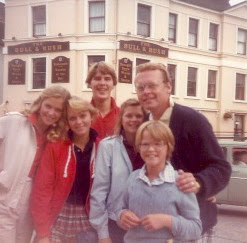
Siblings with Dad in the cute town of Ashburton: Me, Ginger, Greg, Terri
and Heidi (our little brother Peter Jon, suffering a bout of chicken pox,
 had to stay hone in California - I think he got a new bicycle out of the deal!)
Not only that, we were "The Bears"!  Dad had adopted the affectionate "Bear Family" moniker after hearing the jazzy Three Bears song, composed by Bobby Troup in the 1950's after the well known children's story. [trivia note: Troup, a Sigma Alpha Epsilon like my father, also wrote Get Your Kicks on Route 66, another of Dad's favorite jazz tunes].

The Three Bears song was made popular by the Page Cavanaugh Trio, Ray Ellington Quartet, and Leon McAuliffe.


With both our parents being wonderful musicians, my brothers and sisters and I were blessed to grow up with lots of music in our home.  Our family was often requested to sing our own fun version (a musical amalgamtion of the two Youtube videos I've embedded) of The Three Bears, for friends.

Mom, a classically trained pianist, wouldn't miss a beat as she'd pound out the tune and sing the "Mama Bear" part, while Dad - in his booming bass voice - was the "Daddy Bear", and we kids were collectively "the little girl with blond hair" (aka Goldilocks) and the "Little Wee Bear".

I love this picture of my dad in the early '70's with his guitar!
Today marks 40 Days since my dad's passing. I'm dedicating this post to my precious Mom, 5 siblings, "GeeGee's" 20 grandchildren, and his soon-to-be-born first great grandson.  We'll never forget our wonderful Daddy Bear!  Memory Eternal!

"Bye, bye, bye," said the Daddy Bear
"Goodbye, bye, bye," said the Mama Bear
"Hey Babba Ree Bear," said the Little Wee Bear...
So ends the story of the Three Little Bears!

Four of us six siblings - Ginger, Greg, Heidi and me - with our
Dad and Mom, being silly in Devon, England, 1982.
[photo taken by my sister, Terri]

Blogroll