The Illustrated YA Novel is Coming of Age


I've written a YA futuristic novel that I'm putting final polishes on. I'm also an artist, so I'm experimenting with doing ten illustrations for this novel. No can do, you say? Not for YA? I'm happy to report this is no longer the case! The age of the illustrated YA is coming of age. Pictured here is a peek at my image of a scary cult that my main characters run into in the Great Chihuahua Desert. Yup, these cowled creeps are raising the net on my guys. Oh, and those rock formations that look like... well, stay tuned. In fact, stay tuned in general, as I may post another picture soon.

Examples of lushly-illustrated YAs are popping up all over the place. Scott Westerfield's Leviathan, with art by Keith Thompson comes to mind. A Monster Calls, inspired by Siobhan Dowd, written by Patrick Ness and illustrated by Jim Kay is another shining example. Miss Peregrine's Home for Peculiar Children, a novel by Ransom Riggs and chock full of vintage photos, takes the already eerie novel about a 16 year-old boy sent to a crumbling, abandoned home for dangerous youth to a whole other layer of strange. Beth Kephart, a YA author posted on September 29th about this very subject, and she's excited to say that an upcoming book of hers will be illustrated.

So, who says teens shouldn't enjoy evocative images! There's no reason that gorgeously illustrated novels should only exist for the picture book and middle grade set. N. C. Wyeth and Albrecht Durer are two classic picture-makers for adult and crossover novels. With the rise of the graphic novel and the text art hybrid that Brian Selznick introduced with The Inventions of Hugo Cabret, this is fast-changing, and I, for one, am hugely excited about it.

That said, I do think that illustrations for teens need a sophistication that allows for one's imagination to paint in the main characters. Good illustration, as good fiction allows for this breathing room.

That's why, in my pictures, I'll have no images of the main characters (Or maybe one, from the side view??) and precious few of the other players. That's why I won't be giving away any big gun surprises in them either. No spoilers, only images that fuel a sharper, more fierce imagining.

I firmly believe that images in YA novels can enrich and elevate prose. Seems like the perfect time to break away from old formulas and invent fresh, new templates. What do you think? (Should I do my main players in profile?) Please share any more good examples of this phenomenon. What kinds of illustrations would you not want to see, or really love to see? Dish here.
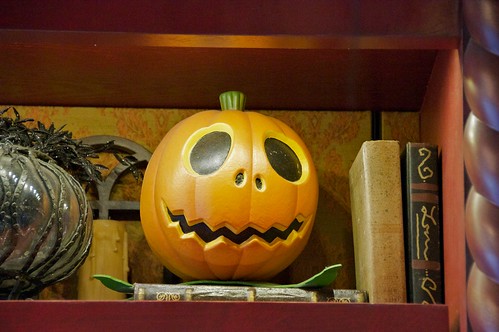
book-or-treat: literary pumpkins!

Jack Skellington pumpkin head
Jack Skellington as a pumpkinhead - source
Before Jack Skellington - the main character in Tim Burton's animated film, The Nightmare Before Christmas - there was L. Frank Baum's storybook character, Jack Pumpkinhead...

Jack Pumpkinhead first appeared in Baum's The Marvelous Land of Oz (published in 1904).  Jack, tall and lanky, with a body made from tree limbs and jointed with wooden pegs, has a jack-o'lantern for a head (hence the name).  But unlike typical jack-o'lanterns, this pumpkin still has all its insides.  In The Road to Oz, Jack has settled in a large pumpkin-shaped house near the castle of the Tin Woodman in Winkie Country. Jack spends much of his time growing pumpkins to replace his old heads, which eventually spoil and need to be replaced. (The old heads are buried in a graveyard on his property.)

In 1913, to publicize the relaunching of the OZ series after a three-year hiatus, Baum wrote a set of six short stories under the series title The Little Wizard Stories. They were each published as separate books and intended for somewhat younger children, in a style similar to today's Little Golden Books.  So children read about Jack again, in the short story, Jack Pumpkinhead and the Sawhorse of Oz.


The 23rd OZ book, Jack Pumpkinhead of Oz was written by Ruth Plumly Thompson, the writer who continued the OZ books after the death of L. Frank Baum.

So, are the similarities between the Two Jacks purely coincidental?
"...in his first scene in The Nightmare Before Christmas, Jack Skellington does have a pumpkin on his head, and looks very much like Jack Pumpkinhead. Also, the director of Nightmare was Henry Sellick who, eight years earlier, had been a storyboard artist on Return to Oz, and therefore had several opportunities to draw Jack Pumpkinhead. From another perspective, similarities can also be seen between Scraps, the Patchwork Girl of the OZ books, and Sally in The Nightmare Before Christmas, so there may be another connection there, but it's also not terribly likely."(source: The Wonderful Wizard of Oz website).
You might like my other OZ post HERE.

Want to explore some other pumpkinheads - Jack-O'Lanterns - inspired by books?  Here's what I found...
Jane Austen inspired Victorian pumpkins

How about a Sleepy Hallow(een) Pumpkin?

Fun party decor, inspired by Edgar Allen Poe's The Raven

Cinderella Pumpkin
Halloween meets Cinderella: 
from allaboutpumpkins.com: "Cinderella" pumpkins are a unique French heirloom whose correct name is "Rouge vif D'Etampes". The source of their nickname it that they resemble the pumpkin that Cinderella's fairy godmother transformed into a carriage. This pumpkin is recorded as having been the variety cultivated by the Pilgrims and served at the second Thanksgiving dinner. There is something magical about them. Cinderellas make a delightful decorative accent for the fall season, but additionally their flavor is good for any pie or winter squash recipe.
"Fairytale" pumpkins ("Musque De Provence") have high, deeply ridged cheeks that are often found in the older varieties. This one is also from France. The greenish-brown coloration of the skin makes it very decorative. It could be the biggest jack-o'-lantern on the block... also good in pies!
Fairytale Heirloom Pumpkin

Cinderella Coach Pumpkin

This cute forest cottage pumpkin reminds me of something you'd read about in one of the THE BRAMBLY HEDGE books, by Jill Barklem.


source

"DEAR LITTLE CATS", HAVING A BALL

THE SONG OF THE JELLICLES, by T.S. Eliot

Old Possum's Book of Practical Cats
Early edition illustrated by Eliot himself

Jellicle Cats come out to-night
Jellicle Cats come one come all:
The Jellicle Moon is shining bright -
Jellicles come to the Jellicle Ball.

Jellicle Cats are black and white,
Jellicle Cats are rather small;
Jellicle Cats are merry and bright,
And pleasant to hear when they caterwaul.


Jellicle Cats have cheerful faces,
Jellicle Cats have bright black eyes;
They like to practise their airs and graces
And wait for the Jellicle Moon to rise...


"Jellicle" is one of many nonsense words invented by T.S. Eliot (in the spirit of Edward Lear and Lewis Carroll). The word shows up in an unpublished poem and in a letter to his godson Tom, in which he sent a spoof party invitation "To All Pollicle Dogs and Jellicle Cats".  It's been noted that "...Pollicle Dogs was a corruption of "poor little dogs", just as Jellicle Cats are "dear little cats". (Maybe three-year-old Tom's mispronunciation?)    Source: an article in The Telegraph, that can be found HERE.

T. S. Eliot’s playful cat poems have delighted readers and cat lovers around the world ever since they were first published in 1939 as Old Possum's Book of Practical Cats, with simple illustrations by the author.  Eliot's 14 original poems were included in a series of letters written to his godson, with Eliot himself posing as "Old Possum".  My favorite edition of the book came out in 1982, with illustrations by Edward Gorey.  Gorey's merry, yet sinister, depictions of cats are perfectly paired with Eliot's mischievously charming poems.


The book inspired Andrew Lloyd Webber's legendary musical, CATS, which opened in London's West End in 1981 and on Broadway in 1982.


I still have my program from a Los Angeles production my husband and I went to see at the Shubert Theatre for our second anniversary in 1985!  If you were lucky enough to see the musical, CATS, you might be interested in reading this excellent review by Janet Karsten Larson, Eliot's Cats Come Out Tonight.  It brought back great MEMORIES for me...wink, wink.

I'll end this post with a few lines from Eliot's "THE AD-DRESSING OF CATS"

...You now have learned enough to see
That Cats are much like you and me
And other people whom we find
Possessed of various types of mind.
For some are sane and some are mad
And some are good and some are bad
And some are better, some are worse--
But all may be described in verse...
But -
How would you ad-dress a Cat?
So first, your memory I'll jog,
And say: 
A CAT IS NOT A DOG.

PUMPKINS (AND JOE JOE'S) ARE HERE!

Look what found it's way into my shopping cart yesterday:  a mini pumpkin and a box of Halloween Joe Joe's!  If you're lucky enough to have a Trader Joe's in your area, you know that Joe Joe's are their version of Oreo's (but Joe Joe's don't contain high fructose corn syrup and the orange cream centers are flavored with real vanilla bean).

These little jack-o'lantern faced cookies are so cute.  My daughter and I did a taste test last night - they are yummy.  But  we have to admit, our favorites are still the Peppermint Joe Joe's that show up on the shelves before Christmas.

Oh, and for fun books about pumpkins, you can check out my past post, by CLICKING HERE.

A VAMPIRE STORY...for children?

No, this isn't a post recommending the Twilight Series for kids.  Today I'd like to tell you about a story involving a strange rabbit, humorously told from the perspective of a Dog named Harold..."I come to writing purely by chance.  My fulltime occupation is dog". 

We learn how Harold's family, the Monroes, acquire ownership of a bunny, who - according to the family's slightly paranoid Cat, Chester - has some strange vampire-like characteristics. The name of this vampire rabbit?

Bunnicula!!!!!


He is so named by the Monroes because they found him at a movie theatre where they had been watching a Dracula film.  

And what are Bunnicula's vampire-like traits that Chester-the-book-loving-Cat is so eager to convince Harold the Dog of?  

Bunnicula has sharp little "fangs",

he has a black mark on his back resembling a cape, 

he sleeps by day, 

and he sucks the juice out of vegetables 
until they turn white. 
     (gasp!)


In reality, Bunnicula, who can't even talk, is no threat to anyone whatsoever. But Chester the Cat is determined throughout the story to have Harold try and kill Bunnicula, which makes for some very comedic plot action. (And a good Halloween story!)


What makes Deborah and James Howe's 1979 vampire bunny book so popular?  He said he thinks readers of all ages are fascinated by the secret lives of animals, much like the ones he's created in his books. "I imagined that as soon as we leave the room, they start talking to each other," Howe said. "It makes it fun for the reader that the animals have this whole life that people are clueless about."
(Quote source HERE)

There are other books in the Bunnicula series, but both of my boys and I only read this first one (and we loved it).  The books are for 8-12 year olds and are great for reading aloud.  By the way, do you know who Chester the Cat is named after?

If you liked this post, you might like last year's Halloween post: A CAT IN THE DARK.

Blogroll